
NVIDIA B200 Tensor Core GPU – Enterprise AI Computing Platform for Large-Scale Data Center Workloads
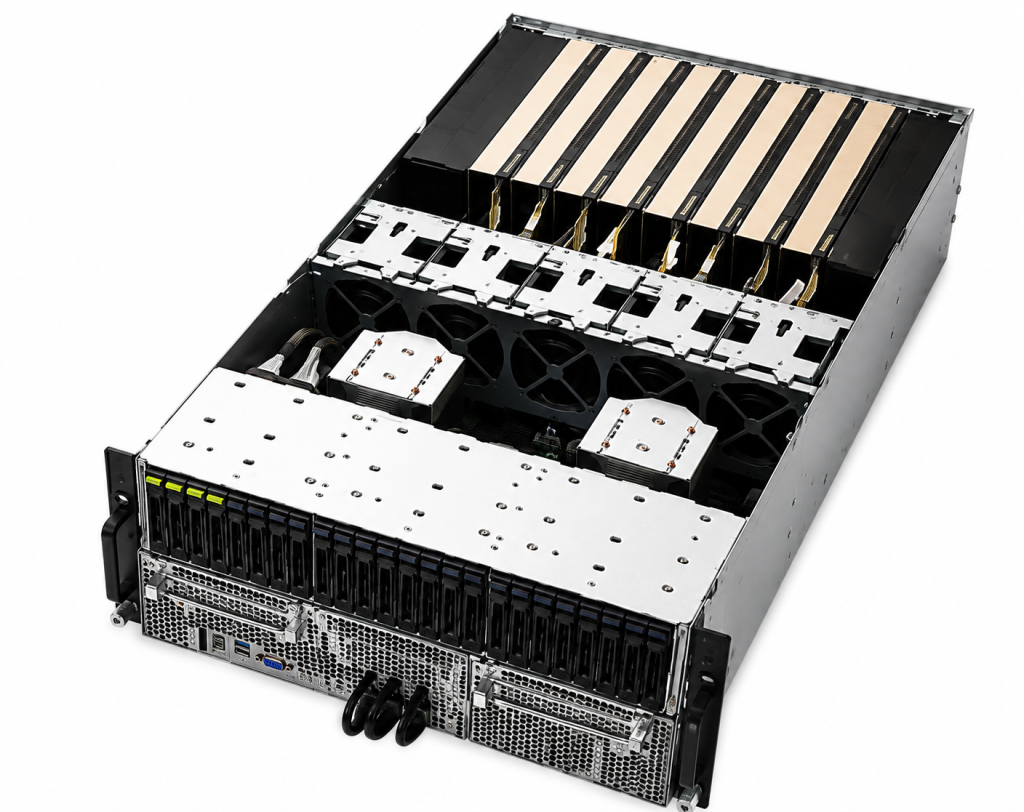
The rapid growth of generative AI, large language models, machine learning, high-performance computing, and advanced data analytics is creating unprecedented demand for accelerated computing infrastructure. Traditional CPU-based architectures can struggle to deliver the performance and memory bandwidth required by today’s most demanding AI workloads. The NVIDIA B200 Tensor Core GPU, based on NVIDIA’s Blackwell architecture, is designed to address these requirements with high-speed GPU memory, advanced Tensor Core acceleration, and high-bandwidth GPU-to-GPU connectivity.
For enterprises building AI infrastructure, the NVIDIA B200 Tensor Core GPU provides a foundation for large-scale training, inference, data analytics, and other compute-intensive applications. NVIDIA’s HGX B200 platform combines eight B200 GPUs with high-speed NVLink and NVSwitch interconnects, creating a scale-up architecture intended for demanding data center workloads.
What Is the NVIDIA B200 Tensor Core GPU?
The NVIDIA B200 Tensor Core GPU is an enterprise-class accelerator based on NVIDIA’s Blackwell GPU architecture. It is designed specifically for accelerated computing environments where large amounts of parallel processing power and high-bandwidth memory are required.
Rather than functioning as a conventional graphics processor, the B200 is optimized for workloads such as:
- Generative AI
- Large language model training
- AI inference
- Deep learning
- High-performance computing
- Scientific computing
- Data analytics
- Model fine-tuning
- Enterprise AI applications
The B200 is commonly deployed as part of larger NVIDIA platforms rather than as a standalone consumer graphics card. For example, the NVIDIA DGX B200 system incorporates eight B200 GPUs, providing 1,440 GB of total GPU memory.
Blackwell Architecture for Enterprise AI
The B200 is part of NVIDIA’s Blackwell architecture, which was developed around the requirements of modern AI and accelerated computing.
One of the key considerations in large AI models is the ability to move enormous amounts of data between compute resources and memory. Consequently, GPU performance is not determined only by raw compute capability. Memory capacity, memory bandwidth, and GPU-to-GPU communication are also critical.
The B200 platform addresses these requirements through high-bandwidth HBM3e memory and high-speed NVIDIA NVLink connectivity. NVIDIA’s HGX B200 platform uses fifth-generation NVLink and NVSwitch technology, with up to 14.4 TB/s of aggregate NVLink bandwidth and up to 1.8 TB/s of GPU-to-GPU bandwidth.
NVIDIA B200 Tensor Core GPU Key Features
180 GB HBM3e GPU Memory
Each B200 GPU in the HGX B200 configuration provides 180 GB of HBM3e memory. An eight-GPU HGX B200 platform can therefore provide up to 1.44 TB of GPU memory.
Large GPU memory capacity is particularly important when working with large models and complex datasets. It can help reduce the need to divide workloads into smaller pieces or repeatedly move data between GPU memory and other system resources.
High Memory Bandwidth
The B200 platform is designed for extremely memory-intensive workloads. NVIDIA documentation lists up to 8 TB/s of memory bandwidth per B200 GPU, while the eight-GPU HGX B200 configuration provides up to 1.44 TB of total HBM3e memory.
High memory bandwidth is useful for applications where processors need to access large datasets rapidly, including AI training, inference, scientific workloads, and advanced analytics.
NVIDIA Tensor Cores
Tensor Cores are specialized processing units designed to accelerate matrix and tensor operations that are fundamental to modern AI and deep learning.
The B200 supports multiple precision formats, allowing AI applications to balance computational performance and numerical requirements according to the workload. NVIDIA’s HGX B200 documentation lists FP4, FP8/FP6, INT8, FP16/BF16, TF32, FP32, and FP64 capabilities.
This flexibility is particularly relevant for organizations running different stages of the AI lifecycle, from model development and training to deployment and inference.
NVIDIA B200 for Large-Scale AI Training
Training large AI models requires substantial computational resources because the system must repeatedly process enormous datasets while adjusting model parameters.
A single accelerator can provide significant computational capability, but large-scale model training typically requires multiple GPUs working together.
The HGX B200 architecture connects eight B200 GPUs through NVIDIA NVLink and NVSwitch. NVIDIA states that the HGX B200 platform can deliver up to 144 petaFLOPs of AI performance and up to 1.44 TB of GPU memory.
This scale-up architecture is designed to keep multiple GPUs working efficiently on demanding AI workloads.
NVIDIA B200 for AI Inference
Training is only one part of the AI lifecycle. Once a model has been developed, enterprises need infrastructure capable of serving predictions and generated content to applications and users.
AI inference can include:
- Generative AI assistants
- Large language model applications
- Recommendation systems
- Computer vision
- Natural language processing
- Enterprise search
- Automated content processing
- Real-time analytics
The B200’s large HBM3e memory capacity and Tensor Core acceleration make it suitable for demanding inference workloads where model size, throughput, and response time are important considerations.
NVIDIA’s enterprise reference architecture specifically identifies AI inference and AI training as use cases for HGX B200 configurations.
NVIDIA B200 and Generative AI
Generative AI models can contain billions or even trillions of parameters. As model complexity increases, infrastructure needs to provide sufficient memory capacity and high-speed communication between accelerators.
The B200 is designed around these requirements.
Its combination of:
- Large HBM3e memory capacity
- High memory bandwidth
- Tensor Core acceleration
- NVLink connectivity
- NVSwitch-based multi-GPU architectures
makes it well suited to the infrastructure requirements of large generative AI deployments.
The technology can be incorporated into enterprise AI clusters where multiple GPUs operate together as a larger computing environment.
NVIDIA HGX B200: Scaling the B200 GPU
The NVIDIA HGX B200 is an eight-GPU platform built around B200 GPUs. NVIDIA describes it as a Blackwell x86 platform designed for scale-up infrastructure.
The platform includes eight B200 GPUs, fifth-generation NVLink and NVSwitch technology, and up to 1.44 TB of GPU memory. NVIDIA also lists 14.4 TB/s of total NVLink bandwidth for the HGX B200 configuration.
This architecture allows enterprises and data center operators to build systems capable of handling workloads that would be difficult to accommodate efficiently on smaller GPU configurations.
NVIDIA DGX B200 System
The B200 GPU is also available within NVIDIA’s DGX B200 AI infrastructure platform.
The NVIDIA DGX B200 integrates eight NVIDIA Blackwell GPUs with a total of 1,440 GB of GPU memory and 64 TB/s of HBM3e bandwidth. NVIDIA lists up to 144 PFLOPS of FP4 Tensor Core performance and 14.4 TB/s of aggregate NVLink bandwidth for the system.
DGX B200 is positioned as a complete AI infrastructure system rather than simply a GPU component, making it relevant to organizations deploying enterprise-scale AI environments.
NVIDIA B200 for High-Performance Computing
Although AI is one of the primary applications for Blackwell-based infrastructure, GPU acceleration also plays an important role in high-performance computing.
HPC applications can involve highly parallel calculations that benefit from thousands of GPU processing cores operating simultaneously.
Potential workloads include:
- Scientific simulations
- Engineering calculations
- Computational fluid dynamics
- Molecular modeling
- Financial modeling
- Research computing
- Large-scale data processing
The B200’s combination of compute acceleration and high-bandwidth memory can help support these demanding workloads when incorporated into appropriately designed GPU computing systems.
NVIDIA B200 for Data Analytics
Modern enterprises generate enormous volumes of structured and unstructured data. Processing this information quickly can be important for business intelligence, scientific research, fraud detection, recommendation systems, and other analytical applications.
GPU acceleration can complement CPU-based infrastructure by processing highly parallel operations efficiently.
The NVIDIA DGX B200 platform is described by NVIDIA as being designed for AI infrastructure and workloads ranging from analytics to training and inference.
Enterprise Data Center Considerations
Deploying B200-based infrastructure involves more than selecting a high-performance GPU. Organizations should evaluate the complete data center environment.
Important considerations include:
Power
High-performance AI accelerators have substantial power and thermal requirements. NVIDIA’s HGX B200 documentation notes that an individual B200 GPU can be configurable up to 1 kW in applicable platform configurations.
Data center operators therefore need to evaluate rack power availability, cooling capacity, power distribution, and infrastructure efficiency before deployment.
Cooling
AI servers equipped with multiple high-performance GPUs generate significant heat. Depending on the system design and deployment requirements, organizations may need advanced air or liquid cooling solutions.
NVIDIA notes that HGX B200 baseboards can be paired with air- or liquid-cooling solutions as part of complete server configurations.
Networking
Large-scale AI systems depend on high-speed networking and GPU-to-GPU communication.
In an HGX B200 environment, fifth-generation NVLink and NVSwitch provide high-speed communication between GPUs, while additional networking components can connect the server to other nodes within an AI cluster.
NVIDIA B200 and Virtualized AI Infrastructure
Enterprise environments may also require GPUs to be shared among different workloads or applications.
NVIDIA’s AI Enterprise documentation supports MIG-backed and time-sliced vGPU configurations for Blackwell platforms, including the HGX B200 180 GB configuration. This can provide options for allocating GPU resources to different workloads depending on the deployment model.
This capability can be relevant for organizations operating shared AI infrastructure, private cloud environments, or multi-tenant GPU platforms.
Why Choose the NVIDIA B200 Tensor Core GPU?
Organizations evaluating enterprise AI accelerators typically need to consider more than peak performance. Memory capacity, scalability, software compatibility, networking, cooling, and long-term infrastructure requirements all influence the suitability of a platform.
The NVIDIA B200 Tensor Core GPU brings several of these capabilities together:
- Blackwell architecture
- 180 GB HBM3e memory per GPU in HGX B200 configurations
- High memory bandwidth
- Advanced Tensor Cores
- Fifth-generation NVLink connectivity
- NVSwitch-based multi-GPU scaling
- Support for AI training and inference
- HPC and analytics capabilities
- Enterprise virtualization options
Together, these features make the B200 an important building block for modern AI data centers.
Conclusion
The NVIDIA B200 Tensor Core GPU represents a major generation of accelerated computing designed for the scale and complexity of modern AI workloads.
With high-capacity HBM3e memory, advanced Tensor Core acceleration, and high-speed GPU interconnect technologies, B200-based platforms can support large-scale AI training, inference, generative AI, HPC, and data analytics.
For organizations planning enterprise AI infrastructure, the B200 is best evaluated as part of a complete platform that includes GPU servers, networking, storage, cooling, power, software, and management infrastructure. NVIDIA’s HGX B200 and DGX B200 platforms demonstrate how multiple B200 GPUs can be integrated into scalable systems for demanding data center environments.
For businesses sourcing enterprise computing and data center hardware, Saitech can provide access to a broad range of technology solutions. Visit Saitech official website to explore available enterprise infrastructure products and solutions.
Frequently Asked Questions About NVIDIA B200 Tensor Core GPU
What is the NVIDIA B200 Tensor Core GPU?
The NVIDIA B200 is a Blackwell-generation data center GPU designed for accelerated AI, HPC, analytics, training, and inference workloads.
How much memory does an NVIDIA B200 have?
In the HGX B200 configuration, each B200 GPU has 180 GB of HBM3e memory. An eight-GPU HGX B200 platform can provide up to 1.44 TB of GPU memory.
What is the NVIDIA B200 used for?
The B200 is designed for demanding workloads including generative AI, large-scale model training, inference, high-performance computing, and advanced data analytics.
What is NVIDIA HGX B200?
NVIDIA HGX B200 is an eight-GPU platform based on B200 GPUs. It combines the GPUs with high-speed NVLink and NVSwitch technology to support large-scale accelerated computing.
How many B200 GPUs are in a DGX B200?
A NVIDIA DGX B200 system contains eight NVIDIA B200 GPUs, providing 1,440 GB of total GPU memory.
Is NVIDIA B200 suitable for enterprise AI?
Yes. B200-based platforms are designed specifically for data center-scale AI infrastructure and can support training, inference, analytics, and other enterprise workloads.
What is the difference between B200 and a consumer GPU?
The B200 is a data center accelerator designed for large-scale AI and accelerated computing rather than consumer gaming. Its platform emphasizes high-capacity HBM3e memory, enterprise-scale multi-GPU connectivity, AI acceleration, and data center deployment.
What should businesses consider before deploying B200 infrastructure?
Organizations should evaluate GPU server compatibility, power requirements, cooling, networking, storage, software, rack infrastructure, and the requirements of their intended AI workloads. B200 deployments are typically part of complete data center platforms rather than standalone GPU installations.